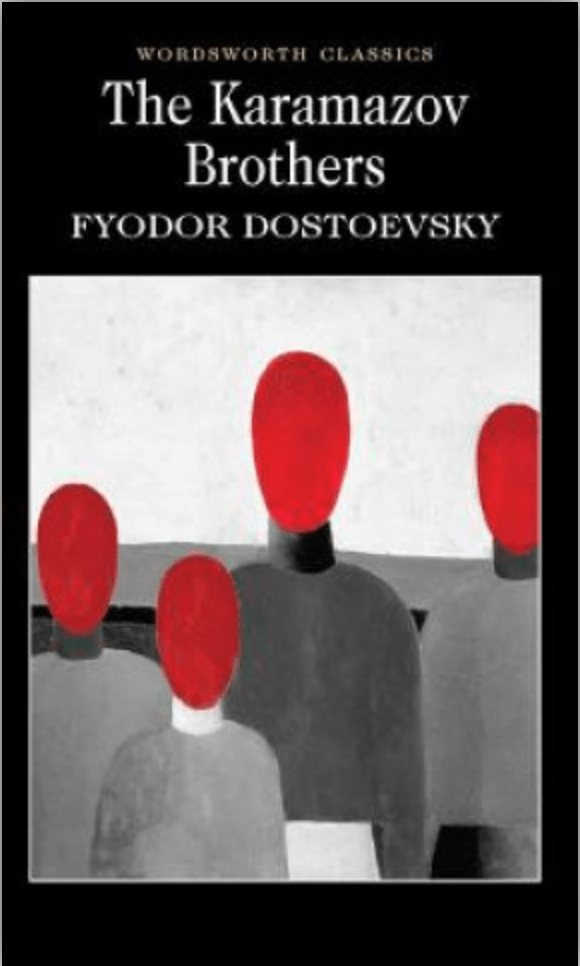
Fyodor Pavlovich Karamazov had three sons and an illegitimate fourth, all of whom he failed to serve as a paternal figure. Through his life Karamazov corrupted the innocence and livelihoods of his posterity through a long list of violations to morality including: the abandonment of his posterity, the hoarding of his family estate as gained through marriage, the abuse and destruction of two wives, the usurpation of his eldest son’s romantic life, and the constant disrespect for his offspring’s prospects or pursuits. Karamazov, a man who failed to fulfill the role of the father left the desire for revenge and consolation embedded in his lineage, of which four differing “sons” demonstrate the potential consequences and means of continuing on past a broken family and childhood. Dostoevsky’s novel culminates in the trying of Dmitri Karamazov for the murder of his father despite a lack of clear evidence which ends in a miscarriage of justice that condemns Dmitri to Siberia despite his innocence as revealed by the confession of the fourth abandoned and indentured son, Smerdjakow.
The representation of a family conflict in a mass trial allows Dostoevsky to comment both on the Russian individual, religiosity within society, and the Russian justice system which social pressure and moral judgment corrupt. The court trial, written in the style of entertainment, critiques the Russian justice system and the fallible nature of witness due to social pressures for the positive representation of one’s character. The trial’s speakers seem much more concerned with their own representation than the truthful conclusion of the case. Dmitri, though by no means innocent, did not murder his father, and yet must face the punishment for it, while the actual murder’s reputation remains untarnished in death after committing suicide despite having confessed the murder to Ivan. Further, while no real evidence could be brought against Dmitri, no evidence could be brought in his defense either. Thus, Dostoevsky’s critique of the judicial system emerges. After the murder of a man, the idea of escape for the criminal was inconceivable, leaving the people searching for the culprit of which there were only two options, Dmitri and Smerdjakow, whom even the prosecutor claimed to feel poorly accusing. Neither man had an alibi and had access to the manor on the night of the murder, which despite not proving either as murders created an infallible suspicion. In the end, Dmitri, who undoubtedly appeared more suspicious considering his frantic and insane manor, bloody, fights with his father, and public reputation as a scoundrel, faced conviction. While in most circumstances the conviction of a man known to beat and threaten murder to his father seems reasonable, the case was complicated by Smerdjakow’s confession. He admitted to Ivan that while Dmitri had beaten his father he had never murdered him, a claim he confirmed by admitting to his own murder and robbery of Fyodor Karamazov, the father that abandoned him. However, the revealing of this claim in court was written off as insanity in Ivan in response to the stress of losing a family member and watching the trial of his brother. Confession was overthrown by the guilt insulated by convicting a dead man to a murder and thus, allowing the murder to go unpunished.
Given the circumstances, a truthful conviction seems impossible. The Karamazov family’s affairs were beyond complicated as well as beyond immoral, so much that no one brother remained unscathed from the tumultuous spirit of the Karamazov name. The entire case was shrouded in obscurity and conflicting stories, as well as supported by evidence that was often disproven. And yet every viewer’s opinion was absolute. The women wished for Dmitri’s release, likely due to his flirtatious nature that enticed him to them. The men all wished for his conviction to punish his cruel murder of his father. A case with no clear truth or absolute outcome placed a determinedly innocent man in prison for the rest of his life due to blindness by a society obsessed with justice through condemning evil. Likely such strong opinions emerged from the immense valuation of one’s character and intelligence. Every member of society determines themself to be right while fearing saying or doing the wrong thing for being labeled a scoundrel. It is in this environment of intense convictions that a polarized community falsely convicts a man, leading to the notion that Dostoevsky’s real critique is of the allusion of truth created by social conventions. When the preservation of reputation overpowers morality and truth, a society loses sight of actual good and evil, a point further provoked by the lack of innocence in the entire Karamazov family. Thus, it is not that good and evil no longer exist, but that the complication of modernity makes their recognition almost impossible as every individual is composed entirely of both.
While Smerdjakow completed the final murder, Dmitri still beat his father, Ivan still left town in hopes that Dmitri murder Fyodor, and Alyosha ignored his spiritual superiors warnings of a darkness in Dmitri’s soul that would lead to violence. No member of the corrupt family maintains total innocence in the affair, and yet only once faces conviction and only two’s names are mentioned as suspects. Thus, the court system, in addition to being unreliable, fails to encompass the entire banality of evil for only the illegal is condemned by the law and not the immoral. While this is not to say that Dostoevsky believed that morality should be used in the implementation of governance systems, he clearly saw a lack of protections against immorality within governing. Not every criminal is evil, while not every innocent man is good. Thus, the actual action of punishment fails to show the righteousness of a character, despite its role in a society obsessed with the outward portrayal of morality.
In addition to praying the limitations of the justice system, Dostoevsky’s novel also strives to determine the actual meaning of what good or evil is in existence as well as if any person is actually good. The closest representation of goodness in his work is Alyosha, but like everyone else Alyosha has faults and isn’t the perfect idealistic monk that he wishes to be. He, follows a religion on which other characters cast doubt and believes in his own righteousness, and yet never condemns his seemingly guilty brother or anyone for the murder of his father. In fact, Alyosha never shows any grievance for his father, focusing instead on an ailing boy and his own spiritual pursuits. A novel which condemns the murder of a father by his son offers no condemnation of the neglect of the same father, nor any punishment for the father who neglected his children leading to such a circumstance. The only concern is the upmost crime of murder with no consideration for the others. Were no murder to be committed abuse and interfamily conflict would have gone unobserved and even during the case the family’s circumstances are only mentioned in Dmitri’s quickly ignored defense. No one individual is inherently good in Dostoevsky’s world, but that does not mean that he supports the nihilistic ideal of good and evil not existing. Rather, Dostoevsky sees people as complex beings who all participate in good and evil acts. Dmitri, who beat his father, also offers the peasantry handfuls of money, has a reputation of honesty, and feels immense guilt for a past theft he committed. The character who Russia views as evil clearly isn’t just evil, but a person, showing that while the idea of good and evil isn’t non-existant, that it also doesn’t encompass the individual as no one person can be defined by a single category.
 Aubrey Wallen Literary Journal and Papers
Leave a comment