The young woman pulls the starving man to her milk-full breast.
The young woman, grieving her still-born child, pulls the starving man to her milk-full breast.
The young woman, who has been abandoned by the father and left to birth a lifeless child, pulls the dying man to her breast and fills him with the milk to surpass death.
She has lost her home and been forced into a constant migration up and down the coast of California in search of work, in search of life. She has feared the death of her child who may be smitten by the Lord for her own wrongs, should she dance and hug or feel too much joy in a time of death. She has been broken and her life fractured into pieces with no opportunity left except an antique, faded dream, and yet she pulls the starving, dying man to her milk-full breast and offers him a second chance at life to surpass death
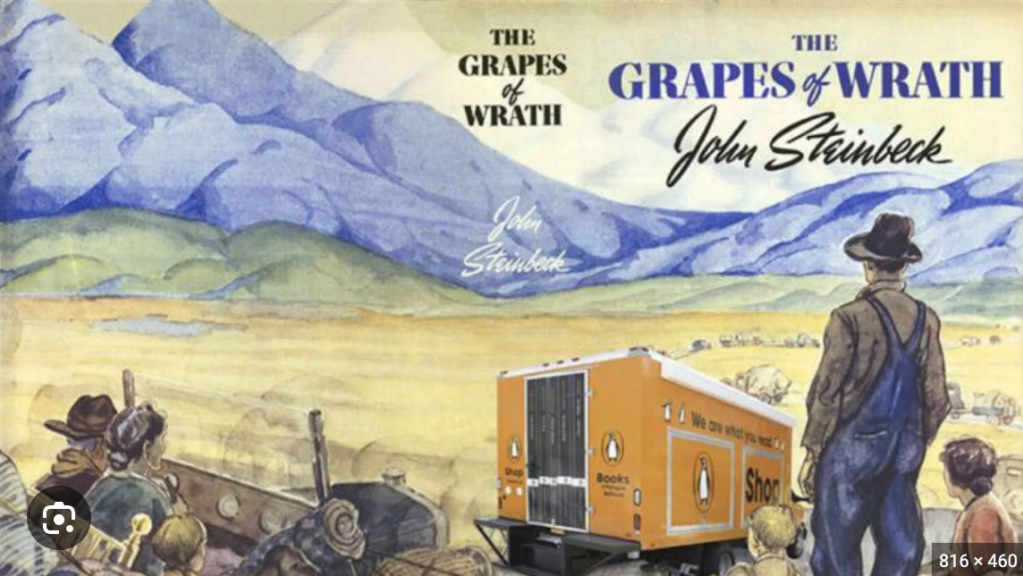
The woman here shown gives the man salvation. At the cost of her body and social dignity, she has become his hero, offering him further life. Despite the death of her child, her body can still give life to another man. Despite the end of her own family, another will always emerge in a constant display of human resilience and perseverance. This image of rejuvenation from tragedy is the final scene of John Steinbeck’s famous American novel, The Grapes of Wrath. The novel follows a family of farmers from Oklahoma who are forced to move West to California due to the devastating environmental and economic effects of the Great Depression and Dust Bowl. The mechanization of farming stole the livelihood of the American farmer in exchange for mass profiteering of a single landowner. Further the intense focus on profits led to the infertility of the land from overuse and a lack of ecological diversity. Combined with the increasing cost of living, unemployment rate, and amount of homeless people, the Great Depression was a time period that seemingly condemned survival and forcibly dehumanized its victims.
The Joad family drives night and day from Oklahoma to California in a run-down Jalopy and only 140 dollars to their name. They follow the call of yellow pamphlets urging men West and offering thousands of jobs, but upon their arrival the allusion of the West as a land of prosperity and destiny sharply shatters. The migrant workers stay in torn, cardboard tents, while fighting over jobs that pay less than five cents an hour. With hunger growing in their stomachs, the migrant families were left with no options but labouring in fields of food that they weren’t allowed to eat while withering to skin and bones baked with exhaustion and summer heat.
The truth of the poor man’s suffering during the Great Depression emerges in the work of Steinbeck, and yet, despite the horror of an entire nation’s lower and middle class slowly facing starvation, the novel holds little sadness. The son returns home from prison to see his life in ruins and his family displaced from his childhood home. The grandfather dies before the family makes it beyond Oklahoma’s state lines. The grandmother dies while driving across the desert to California and the mother sits alone with her dead body in the back of the car. The young woman who is racked with fear about the approach of motherhood loses her child and her husband as he walks away when hardship strikes. And finally, the novel finishes on the image of starvation with an old man’s only hope being in a young girl’s breast milk from a child, lost. Every possible devastation has berated the Joad family and yet the style of novel refuses mourning. Suffering is accepted as fate and thus loss, poverty, and death don’t evoke tragedy, but blend in with a constant atmosphere of morbidity and emotional numbness. Devastation can be found in every corner, but to acknowledge it all would mean to give up on living life, a sacrifice which the Joad family refuses to make.
Rather, the family constantly searches for hope and prospective happiness. They eat a hearty soup on a hard day in the Hooverville and listen to the prayers of one another. They find contentment in one another and their dreams of the future, and in the end despite the loss of family members, the remaining Joads have each other. There’s the prospect of a new marriage and the new life that might stem from it. There’s the hope of finding more work in the coming fall. There’s hope of community amongst the displaced. The migrant family refused to sacrifice the most important thing – their humanity and dignity. Amidst hardship, their principles remain: religion, propriety, family, and hard work. Amidst the fracturing of a nation, the family fought for togetherness with brutality and perseverance they were unaware they even had.
John Steinbeck’s writing captures the perseverance of the human soul against degradation and hardship. He wrote a narrative that portrays the necessity with which a family chose perseverance without questioning the purpose of continuing on. Even when oppressed to less than nothing, people will always continue fighting. No group facing subversion and treachery will ever not be a threat to the dominant power, for the human spirit will always combat its oppressors and circumstances.
The political ramifications of Steinbeck’s work become more apparent in the various chapters which break from the Joad’s family’s experience to capture how wide-spread the effects of the Great Depression were. The narrative style switches to an all-knowing, prophetic voice which writes in a warning tone. A textual overseer writes of the Migrant families in whole as though they were a single entity. The narrator warns about the danger of those who are hungry to those in power and the desperation which protecting one’s youth can invoke. Thus, Steinbeck, in addition to writing of perseverance, makes it abundantly clear the role his writing should play. The Grapes of Wrath urges the importance of perseverance in rebellion against imposed hardship and the suppressions of specific groups. The oppressed will always riot as says the cycle of history and the persevering nature of the human spirit.
 Aubrey Wallen Literary Journal and Papers
Leave a comment