- Section 1: Wagner and Joyce–The Ideologies
- Section 2: Ulysses als Gesamtkunstwerk und Bewusstsein
- Section 3: The Inverted Myth and Modernity
- Annotated Bibliography
James Joyce
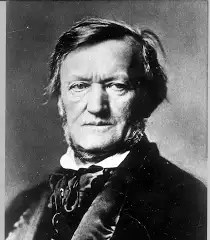
Richard Wagner
Section 1: Wagner and Joyce–The Ideologies
The novel Ulysses by James Joyce belongs to the modernist literary movement: a nineteenth and twentieth century movement that, through literature, examined the world in a non-linear and absurdist manner that strove to accurately depict the human consciousness without the idealization of the subject. Modernist literature does away with ordinary conventions and strives to show reality and truth within everyday life by exploring the subconscious. As inspired by this growing emphasis on human experience, Joyce’s Ulysses details the city of Dublin so specifically, that it has been claimed the city could be reconstructed solely from the work of Joyce should it ever face destruction. The novel, which depicts an ordinary day–June 6, 1904–in the Odyssey’s mythic structure, deals with themes of religion, race, gender, philosophy, politics, and what it means to be human in an ever expanding, modern and nationalist world. Clearly Joyce’s work garnered influence from popular literary tradition and his cultural surroundings, most notably for the context of this paper, Richard Wagner. Wagner, who became a praised composer of Germany’s third reich, crafted theories on aesthetics and the purpose of drama, particularly the “Gesamtkunstwerk” and the “Bewusstsein,” both of which make clear contributions to Ulysses and Joyce’s overall perspective on Drama. However, Wagner believed art to serve as a tool to idealize a nation as superior as revealed later in his life, leading to an obligatory investigation of Joyce’s opinions on nationalism and how they appear in Ulysses to maintain a careful awareness of our own interactions with dangerous political ideologies and nationalism when consuming literature.
Joyce encountered Wagner from a young age due to his family’s musical nature. Each of his family members sang, and his father was described as having one of the finest tenor voices in Ireland. His parents initiated Joyce to the study of voice and piano at age nine, skills which enabled him to perform on the same stage as John McCormack, an accomplishment which convinced Nora Joyce that he should have chosen a career in performance over writing (Martin “Joyce, Wagner, and the Artist-Hero”). This involvement with the musical realm would have given Joyce ample introduction to Wagner’s musical material, but further, he would have encountered Wagner and his theories in Irish literary tradition. Wagner’s theories look at art as a means of capturing a national consciousness, a principle that ties artistic creation closely to nationalism. He sought “to elevate opera to the status of a serious art form – in particular that of Greek drama, the ideal his prose writings continually invoke,” and as a result compared art between nations and cultures as a means of determining superiority (Martin 2). Similarly the Celtic Revival emphasized literary revival by promoting a national Irish Literature and advocating for the founding of the Library of Ireland in 1845 (Jackson). Thus, the Celtic Revival, with inspiration from Wagner sought to create a national consciousness through creating a collection of modern Irish literature to represent the nation’s growing pride in its cultural origins and to support independence from Britain, and Joyce served as a member of this revival. Given both Joyce’s musical and literary involvement with Wagner’s repertoire it becomes apparent that one must understand Wagner’s ideologies and theories as there can be no doubt of their influence upon Ulysses.
The biography Art, Life, and Theories of Richard Wagner by Edward L. Burlingone describes the three main facets of Wagner’s values: that he desired to elevate the status of opera and drama to its ancient status, that he sought to create a Gesamtkunstwerk, and that he believed good art was created from a national consciousness and thus provided a representation of a society’s psyche. In his text Opera and Drama, Wagner wrote, “the means of expression (music) has been made the end, while the End of expression (drama) has been made the means” (Martin “Joyce and Literary Wagnerism”). This lack of seriousness attributed to drama inspired many of Wagner’s beliefs as he saw art as a means of inspiration and collective understanding that could enable the unification of every man with aspirations. Through a combination of his nationalistic principles and his knowledge of Greek, Latin, and mythology Wagner created his aesthetic theories, which he published in The Artwork of the Future.
Wagner first invented the Gesamtkunstwerk due to his disapproval of rowdy theater crowds and inappropriate applause that broke the immersion of drama as well as his desire to make drama be taken seriously once again. He designed his own theater and enforced strict arrival times on his patrons. The theater would be pitch dark and the seats would encircle the podium so the audience could more fully feel, hear, and see a story without interruption and absorb a masterwork that utilized all art forms. According to Haley in her article, “Modernism’s World Drama: Joyce, Wagner, and the Anti-systemic Stirrings of a Global Artwork,” this was not an attempt to restore the model of Ancient Greek tragedy, but an inversion of this tradition to propose a new revolutionary model, which leads to the second major idea offered by Wagner to aesthetics–the collective public consciousness or “Bewusstsein.”
Wagner wrote, “In like manner will Art not be the thing she can and should be, until she is or can be the true, conscious image and exponent of the real Man, and of man’s genuine, nature−bidden life; until she therefore need no longer borrow the conditions of her being from the errors, perversities, and unnatural distortions of our modern life” (The Artwork of the Future). He believed art collected the volk into a singular consciousness, as was the sole responsibility of the artist, just as he believed every man with aspiration should dedicate his life to politics (Haley). Wagner believed art should pursue truth and be capable of representing a community in a shared experience or feeling, leading him to draw upon more untraditional and provocative themes that were gaining traction during the nineteen hundreds. Scholar, Timothy Martin, claims “With their religious symbolism and sexual themes, Wagner’s operas represented a challenge to public standards of taste and morality, creating a division that only increased the enthusiasm of his followers” (23). Wagner employed sexual or improper themes, not for enjoyment, but in the tradition of examining the unconscious or passionate sides of individuals that thus far had been restrained from the public eye in artistic compositions. Thus, his compositions were seen as the music of the future due to their uncanny awareness of human experience, and his ideas were incorporated into movements for change, which led to James Joyce’s interactions with his ideals and more so his aesthetic theories (Martin 25).
However, while his work was associated with an emerging central liberalism and was utilized in the creation of new modern arts and movements, Wagner’s art also dangerously coincided with extreme nationalism. In 1848, Wagner published a series of essays while in exile in Dresden that attributed the purpose of art to be to showcase the power and mastery of its creators nation.While his aesthetic theories remained the same, rather than the creation of a public consciousness, Wagner now advocated for the creation of a national consciousness that abided by revolutionary ideals. Inspired by various revolutionary uprisings, Wagner’s work became the basis for nationalism and an emerging liberalism and imperialism (Haley). He believed in artwork that could only be created when society reached unity as the ancients did under a common mythology, furthering his nationalism as the nation replaced the mythic as the binding of civilization. Further, this mindset amplified Wagner’s blatant anti-semitism that would go on to make his work compatible with the Nazi Party and enable his complacency to the Third Reich. Thus, while Wagner represented a disillusionment with positivist social thought and bourgeois culture with its high moral standards and immense rationalism, it also represented the growth of nationalism in the eighteenth century (Haley).
Given Wagner’s complicated ideas that both represented progress but also fueled nationalism and were eventually praised by the Nazis for the ethnographic ranking of art and hellenistic influence, it seems surprising that he served as an influence for James Joyce–a stark anti-nationalist. This paper has shown that Joyce’s introduction to Wagner stemmed from the fascination which the Irish literary imagination had for Wagner’s aesthetic contributions and the emphasis placed on nationalist literature by the celtic movement. For example, Yeats credited Wagner for the use of myth as a source for contemporary art and “believed that a drama based on Irish myth could focus Irish political aspirations and develop national consciousness” (Martin 13). The Celtic Revival adopted Wagner’s ideas on drama in hopes of creating a national Irish literature that would represent the Irish spirit and lead the way to independence. However, Joyce clearly critiques Irish nationalism for its exclusionary tendencies and while following Wagner’s ideas of a Gesamtskunstwerk and collective public consciousness, abides also by his own aesthetic theories surrounding the purpose and meaning of drama.
In his essay, “Drama and Intention,” James Joyce released a statement regarding his perspective on what constitutes a drama. In the article “Hegel (and Wagner) in James Joyce’s “Drama and Life,” Robert Baines summarizes the five variables that determined a drama for Joyce. Joyce believed a drama must represent emotional conflict, should be more so concerned with the internal than the external world, be capable of assuming many forms, be constant and timeless, and be concerned with everlasting hopes, hates, and desires. Essentially, Joyce saw drama as a universal vessel for the truth of the subconscious, a means to understanding the world and people in meaningful ways, free from conventions. Further, Joyce thought it was impossible for a drama to be vulgar as how can the expression of true human feelings and existence be categorized as unacceptable (Baines)? Drama, a variable art form which strives to reveal the interior, would only be limited from discovering the truth of experience if it were to be held subject to the standards of everyday morality.
In description of drama, Joyce coined the term world-drama, as discussed by Haley. In her article, Haley writes:
“ The first thing that must be said about this account is that drama, for Joyce, does not simply refer to the theatrical medium, but instead names a privileged quality to which all modern art can aspire. What defines drama in art then, first, is its universal import and orientation to the world at large: drama is “of widespread domain” (26) and provides “a symbolic presentment of our widely related nature” (25). Second, drama is revolutionary in its opposition to the sanctioned views of art and the world: “drama will be for the future at war with convention” (25).”
Joyce’s definition of drama diverges from the exact thought of Wagner, though that is not to say it isn’t influenced by it, nor that Joyce’s Ulysses doesn’t follow the theory of the Gesamtkunstwerk or the creation of a public consciousness. Joyce’s works, rather than fueling a liberal-imperial ideology like Wagner’s, actually opposes such. Joyce’s definition of drama views art as concerned with strife, evolution, and movement. It concerns itself with communal art, which while curating a literary, public consciousness based on an intimate, observational depiction of the world, does not necessarily constitute a national consciousness.
This split in aesthetic values mirrors that of Nietzsche with the composer. After watching a rehearsal for Wagner’s performance at Bayreuth, Nietsche realized that his values had separated from those of Wagner, a composer who he once idolized as “not only a fatherly friend, an adored artists, but the living embodiment of the philosophic spirit” ever since his discovery of Tristan and Isolde (Foster 19). In his article, “Nietzsche and Wagner,” George Forster synthesizes the root of Nietzsche and Wagner’s split: “Wagner’s goals turned ever more away from life; Nietzsche’s to life. Wagner believed the deepest truths unveiled themselves only in art, in metaphysics, in religion; Nietzsche now held more and more that scientific thought, purged of artistic, metaphysical, and religious prepossessions, was the vehicle of truth” (25). At its core their disagreement hinged on their distinguished opinions on the human as the hero. Wager glorified the modern individual and borrowed figures of myth and legend who he failed to characterize enough to make realistic, leading to his heroic character. Nietzsche, however, believed in observing actuality, a value he shares with Joyce. In “Joyce contra Wagner,” MacNicholas writes, “Joyce found Wagner distasteful for two evident reasons: the Germans had already dramatized with acuteness certain destructive tendencies with Joyce recognized in his own personality; and Wagner’s art rested on the heroic vision of the world” (42). Joyce, like Nietzsche, believed in science and observation. He crafted his characters as experiments to investigate the human consciousness, not to glorify any one inspiration, but to understand humanness.
Thus, Joyce split with Wagner, likely for the same cause as Nietzsche. While Nietzsche and Joyce ventured into the modernist desire to understand the subconscious, Wagner turned to nationalism and imposed the standard of the hero on his protagonists to create nationalism. Wagner in his Total Work of Art, argues that art symbolizes the public consciousness and should be used to unite people into groups capable of political action and the defense of one superior nation (Haley). Therefore, their artistic desires directly oppose one another as Joyce’s concentration on observation and factual understanding of the human psyche inherently placed him in a position to understand the arbitrariness of national glorification which has no factual basis. Thus, Joyce’s Ulysses, while inspired by Wagner, actually serves as a modernist novel that critiques nationalism as well as the capability of myth to represent modernity in its entirety.
Section 2: Ulysses als Gesamtkunstwerk und Bewusstsein
“Joyce’s theme in Ulysses was simple. He invoked the most elaborate means to present it. Like the other great writers, he sensed that the methods available to him in previous literature were insufficient, and he determined to outreach them.” (Richard Ellman Preface)
Given the nature of Joyce’s education and livelihood, the assumption that Ulysses drew inspiration from the theories of Richard Wagner seems indisputable, but the importance of understanding how Ulysses functions as a Gesamtkunstwerk and public consciousness remains. Firstly, Ulysses serves as a Gesamtkunstwerk due to its immersive experience offered by the breadth of literary forms utilized, the fluidity or musicality of Joyce’s writing styles, and the sensual quality of the text which relies on sensory allusion and the recreation of the natural world through acute detail. Secondly, Ulysses, a novel claimed to be capable of reconstructing Dublin should the city ever face destruction, functions as a curation of a public consciousness or Bewusstsein due to its unification of society under myth, religion, and ideologies. Further, it depicts the subconscious of the individual within the characters of Stephen and Bloom.
The Gesamtkunstwerk combines various art forms to create one total, more complete work of art. Ulysses, rather than consisting of various elements–music, writing, dance, lighting–as a stage production might, utilizes various writing styles and narrative techniques which explore the entirety of the artistic forms: prose, poetry, music, drama, news writing, and scientific inquiry among others. The novel takes place in eighteen episodes, each of which stretch the possibilities of language in a masterwork that only a genius of the English language could compose. To offer a brief synopsis of these structural elements, the novel’s introduction of six episodes in which both Stephen and Bloom are thoroughly introduced remains closer to convention than the rest, while the remaining episodes break grammatical rules and stylistic conventions to explore political, religious, philosophical, and psychological themes. While initially jarring, episode seven or “Aeolus” occurs entirely through newspaper headlines which chart out important plot points and brief sections of prose in between to maintain an atmosphere of sensual or intellectual description. Going on, episode nine or “Scylla and Charybdis” begins to incorporate sections of dialogue written like a play, a technique that Joyce expands in episode fifthteen or “Circe.” Not leaving time for his audience to grow comfortable with the format, episode eleven or “Sirens” occurs in the structure of an overture and operatic performance. In “Sirens” a series of repeated phrases or Wagnerian Leitmotifs fill the first two pages foreshadowing the remainder of the chapter which repeats them. Joyce continues his prideful display of knowledge when episode fourteen or “Oxen of the Sun” reiterates the entirety of English literature through a series of parodying imitations. Episode sixteen or “Eumaeus” takes place in the voice of Bloom, a writing style so insufferable that only a great novelist like Joyce could be capable of publishing it right before episode seventeen or “Ithaca” follows the style of a scientific journal in an elaborate exploration of technicality and precision. Finally episode eighteen or “Penelope” is written mostly without punctuation, in four paragraphs that show the first exploration of a woman’s subconscious.
Joyce’s Ulysses explores uncharted conventions of style, removing any comfort from consistency. The reader must immerse themself in each scene he creates, and always race to keep up with the breadth of Joyce’s work. Joyce’s writing sings throughout, but especially in “Sirens,” a chapter that focuses on recreating the noise of the world. It shows repetition and recurring images through leitmotifs that resemble reality, making the reader hear their existence. Joyce writes, “Jingling on supple rubbers it jaunted from the bridge to Ormond quay. Follow. Risk it. Go quick. At four. Near now. Out” (11.304-305). In this phrase, “jingle” represents Boylan, the man who will have had an affair with the protagonist, Bloom’s wife by the end of the day. Bloom hears the sound of the man who will wreak havoc on his marriage and the writing grows choppier, more staccato demonstrating Bloom’s anxiety at the coming affair, and drawing the reader into the anticipation the same way a minor chord or dissonant triad would an audience member during an orchestra.
Further, Joyce explores the other senses or theatrical components in the terms of the Gesamtkunstwerk. The main protagonist, Bloom, shows his reliance on observation of the natural world within moments of his introduction.
“Mr. Leopold Bloom ate with relish the inner organs of beasts and fowls. He liked thick giblet soup, nutty gizzards, a stuffed roast heart, liverslices fried with crustcrumbs, fried hencods’ roes. Most of all he liked grilled mutton kidneys which gave to his plate a fine tang of faintly scented urine” (Joyce 4.1-5)
One, while not delighting in the taste of liver and the scent of urine, has little choice but to witness in gross detail the slimy innards that Bloom consumes. Terms such as “nutty gizzards” or “a fine tang of faintly scented urine” awaken the senses and encompass the reader’s reality. They enliven the words as lights would a stage production or as dancing would a song. The senses provide the various elements of theater or the Gesamtkunstwerk for Joyce. They amplify the experience of reading Ulysses as the combination of multiple art forms and their impacts would. However, in addition to the multiplicity of styles and sensory descriptions, Ulysses also explores the depth of intellectualism and the human psyche, showing it to be an attempt to understand humanity or in Wagnerian terms, the public consciousness. Joyce achieves this depiction of a public consciousness through the representation of individual humanity through both Bloom and Stephen which span the possibilities of the human consciousness.
Various analyses have attempted to understand the relationship between Bloom and Stephen, the most common being that Bloom offers a paternalistic bond to Stephen in which they can both find solace from their mutual ostracization from society. However, while both characters face isolation and neglect by the Dublin community, they also pose as opposites to one another, allowing Joyce to explore the entire range of thought that any person may have. Stephen understands the world through reason while Bloom feels and perceives the world entirely through his senses. Moreso, Stephen understands the world through himself, while Bloom understands the world through its actuality.
Stephen thinks entirely in relation to himself. He places most value on his own intelligence and rather than seeing reality instantly denotes every observation to a deeper meaning based on some insight or allusion. This appears most prominently in episode three, “Proteus” in which Stephen takes a long walk along the beach after being forced out of his home and berated by his boss, Mr. Deasley. At the end of his walk Stephen, “laid the dry snot picked from his nostril on a ledge of rock carefully. For the rest, let look who will” (Joyce 3.500-1). In medieval times picking one’s nose was viewed as the equivalent of picking one’s brain, meaning that Stephen has now smeared not only his snot, but his brain on the rock, just as he has spent his whole walk shouting long-winded, intellectual statements, metaphors, and ideas about. The final section of his walk makes it apparent that Stephen’s references to poetic meters, philosophy, and Shakespeare consume him so greatly that he leaves a piece of himself and his mind where he has spent the last hour thinking. Only intellect ties Stephen to the society, leaving him lonely and without a home to return to that night.
Contrasting Stephen is Bloom, a character who constantly perceives insignificant details about the world, allowing him to see it in its full vividness. From the beginning of Bloom’s first episode, “Calypso” his acutely observational nature becomes apparent. Joyce writes, “Mr. Bloom watched curiously, kindly the lithe black form. Clean to see: the gloss of her sleek hide, the white button under the butt of her tail, the green flashing eyes” (4.21-23). A softness infiltrates Bloom’s view of the world which counters Stephen’s ruthless egoism, a contrast that is only emphasized by the two characters’ different reactions to hearing church bells in the distance. While Stephen immediately begins reciting latin verse, Bloom simply imagines and hears the sound: “Heigho! Heigho!” (4. 544). Bloom’s observant nature connects him to the natural world, but, in terms of actual society he faces as much isolation as Stephen. While Dublin shuns Stephen for his narcissistic tendencies, it shuns Bloom for the opposite, his inability to exist in society due to a lack of self. Bloom’s observantness soon reveals itself to function as a response to deeply rooted insecurities. He has little self-worth since the death of his child Rudy and the crumbling of his marriage, leading him to act subservient to most everyone he encounters. Bloom watches his wife, Molly, conceal a letter from Boylan, her suitor whom she will have an affair with by the end of the day and shows no anger or reaction, only anxiety. However, before going to sleep, Bloom “kissed the plump mellow yellow smellow melons” signaling his forgiveness of Molly (Joyce 17.2241). Bloom forgives Molly for he can not maintain a grudge against one for disrespecting him, when he does not respect himself, and nor does the rest of society. Bloom faces degradation from his wife, an estranged relationship with his daughter, and constant anti-semitism and judgement from the remainder of the Dublin community.
Thus, Bloom and Stephen represent complete opposites of the spectrum of personalities, and yet they still unite for a time due to their shared ostracization. Within “Circe” Bloom follows Stephen into the red light district where he takes on a fatherly role, ensuring Stephen doesn’t get into trouble and getting him home safe. When riding in a carriage with a drunk Stephen, Bloom imagines Stephen as a symbol for his deceased son and what their relationship could have been. Bloom speaks, “Face reminds me of his poor mother. In the shady wood. The deep white breast. Ferguson, I think I caught. A girl. Some girl. Best thing could happen him” (Joyce 15. 4949-4951). While the novel ends with Stephen and Bloom parting paths, Joyce still binds together two characters from opposite parts of Dublin, the middle-class, Jewish, adman and the impoverished teacher who desires to be an artist. Joyce binds together the two outcasts of Dublin that represent each other’s opposites, thus binding together the entire range of Dublin’s consciousness within their juxtaposition. Together, the two men share different values, life experiences, and futures, and yet they share some “common factors of similarity between their respective like and unlike reactions to experience” (Joyce 17.18-19). Joyce writes:
“Both were sensitive to artistic impressions, musical in preference to plastic of pictorial. Both preferred a continental to an insular manner of life, a cisatlantic to a transatlantic place of residence. Both indurated by early domestic training and an inherited tenacity of heterodox resistance professed their disbelief in many orthodox religious, national, social, and ethical doctrines” (17.20-25).
The placement of Bloom and Stephen besides each one another demonstrates the unification of polar opposites, who represent the two extremes of society. Despite Stephen viewing the world entirely through a self-aggrandizing perspective and Bloom through a naturalistic and observant lens, they can still be found to have things in common. These similarities serve Joyce’s Ulysses as the collective consciousness. He includes depictions of most everyone in a society through basing the book on the juxtaposition of two extremes of society.
Whether Joyce intended for Ulysses to accurately portray Dublin’s consciousness is no question as the novel has even been said to depict the city so precisely that it could be reconstructed from the novel alone, should it ever face destruction. However, while through the contrasting of characters, Joyce creates a public consciousness, it remains unclear whether he created a national consciousness, leading to a necessity to investigate Joyce’s own ideas surrounding drama and their relation to the public consciousness. While Wagner valued the Gesamtkunstwerk for its ability to motivate political movements which represented idealized depictions of nations, Joyce seemed to take a more psychological interest in the idea of a communal consciousness. Ulysses never idealizes Dublin, Ireland, but rather, accurately represents it alongside a plethora of social issues including anti-semitism, sexism, poverty, and Irish nationalism. Ulysses strives to show the totality of what it means to be human and to truthfully invite the reader into a character’s mind until they are better acquainted than most people are in actuality. Joyce strives to show the truth of the human experience through his own definition of a drama as discussed prior.
The most explicit failure of Joyce’s novel to fulfill his definition of a drama occurs in the novel’s vulgarity. Facing censorship until the Woolsey decision in 1933, a court case which argued for free expression, the novel has been viewed as obscene for many reasons including scenes with: masturbation, prostitution, and domination fantasies. However, the remainder of the criterion are reached by Joyce’s gesamtkunstwerk–emotional conflict, internally focused, capable of assuming many forms, constant, and concerned with everlasting hopes, hates, and desires–leading to the question of whether Ulysses can actually be vulgar. Joyce was concerned with the most truthful expression of human nature as shown by his novel’s successful categorization as a public consciousness, meaning that such depictions of “vulgarity” are more practically just examinations of the human experience. People encounter masturbation, sex, prostitution, and other desires in real life, making the inclusion of such topics an effort to maintain accuracy to the human experience. The use of obscenity maintains the purpose of truthfulness, eliminating the vulgarity of it, for the vulgar, within Joyce’s drama, serves the purpose of reality.
Thus, Ulysses provides representation of both Joyce’s and Wagner’s ideologies surrounding aesthetics, and further, Joyce’s own aesthetic theories were partially inspired by Wagner whom he grew up surrounded by the works and theories of. There can be no doubt about the role of nationalism in Joyce’s work. He wrote during the Celtic Revival that emphasized the creation of art to protect and rejuvenate Irish culture, a movement that Wagner also inspired. He grew up surrounded by music and theories stemming from Wagner, and his novel, Ulysses deals explicitly with Irish nationalism, especially in regards to hellenism. However, Joyce’s work also concerned itself with the most precise depiction of the human psyche capable of being maintained in any art form as a result of his breaking from Wagner’s fixation on the hero and myth. Ulysses maintains itself as a drama that, while inspired by Wagner, did not uphold his ideas which breached into dangerous nationalism, leading to the necessity of investigating Joyce’s interaction with nationalism in the novel itself.
Section 3: The Inverted Myth and Modernity
Criticism of Irish Nationalism appears within the novel’s first episode, “Proteus,” through the character of Buck Mulligan. Mulligan lives in the Sandycove Martello tower with Stephen. The novel’s introduction provides insight to the unbalanced and cruel nature of Stephen and Mulligan’s relationship in which Stephen, despite earning a better salary, owes Buck excessive amounts of money, which provides the grounds for Stephen’s submissiveness to Buck’s accusative and interrogating nature. In addition to making comments on Stephen’s religion and calling him a “fearful Jesuit” Buck also makes much more personal comments intended to shame Stephen. Buck declares:
“You could have knelt down, damn it, Kinch, when your dying mother asked you…I’m hyperborean as much as you. But to think of your mother begging you with her last breath to kneel down and pray for her. And you refused. There is something sinister in you…” (Joyce 1. 91-94).
Stephen refused to kneel to his mother due a religious conflict, and while the decision can be interpreted as cruel of Stephen, the constant mentioning of this tragic moment by Buck communicates the bitterness of his character. He would reference the death of the mother of his “friend” with no thought for the emotional impact such a statement might make. However, Stephen never retaliates against Buck’s harsh nature due to a feeling of financial indebtedness leading to Mulligan’s ease of ability to take advantage of Stephen, so much that Stephen leaves the tower knowing he won’t be going home for the night while murmuring “Usurper” in reference to Buck (Joyce 1.744).
The intensity of the negative characterizations placed on Buck stand out starkly in the text, tainting any section of the novel in relation to him, and rendering him unreliable as a character that has proven himself selfish and inconsiderate. The undesirable associations placed upon him by Joyce ooze from his character throughout, making for a curious interpretation of his overt nationalism. Buck describes an Englishman: “God, isn’t he dreadful? he said frankly. A ponderous Saxon. He thinks you’re not a gentleman. God, these bloody English!” (Joyce 1.51-2). The question must be posed as to why the novel’s first references to Irish nationalism come from the character who has been designed as so hateable that the readership of Ulysses would feel disgust at him within the first episode. Joyce, by associating Irish Nationalism with Buck, also associates it with his cruelness and his narcissism. Joyce even writes Buck as describing his own name as having a “hellenic ring,” in a self-aggrandizing fashion (Joyce 1.41). Hellenism, a philosophy closely tied to Irish Nationalism as the Celtic Revival sought to make art as grand as the ancients to prove their worth and right to self-rule, takes on a grandiose and self-serving meaning in its use by Buck. He does not wish to free the Irish from the British for freedom, but to prove his own superiority, and Joyce makes this clear through his self-serving nature. Joyce, within the first episode, depicts nationalism as a self-serving assertion of unity that only benefits those who are “worthy.”
However, in addition to being self-serving, Irish Nationalism takes on the role of a bindent amongst society, but also as an exclusionary agent that isolates those who aren’t Irish enough. This appears in the contrast between Stephen and Buck’s respective positions in society as depicted in episode nine or “Scylla and Charybdis.” Stephen presents his theory on Hamlet to a group of academics in this section, but Mulligan responds by mocking him, often for things entirely unrelated to his theory. Joyce writes: “The sentimentalist is he who would enjoy without incurring the immense debtorship for a thing done. Signed: Dedalus. Where did you launch it from? The kips? No. College Green. Have you drunk the four quid? The aunt is going to call on your unsubstantial father…” (9.550-553). This quote shows Mulligan reading a telegram of Stephen’s aloud after disagreeing with his presentation. The telegram relates to nothing Stephen has said, and can only have been to humiliate him, an intention that succeeds as Stephen faces ridicule while Buck goes off to the bar. Buck negates and humiliates others to benefit his own superiority which is only promoted by his nationalistic ideas. Thus, Joyce shows that Irish Nationalism or ideas of superiority rely on the condemnation of another, the same way that Mulligan’s social charisma relies on the bullying of others.
Irish nationalism is just one of many ideological systems used to create unity within Ulysses, none of which Joyce seems to favor more than another. The novel includes questions on religion, politics, gender, social customs, and myth as various means of connecting people within modernity. Men gather in bars and win social favor by securing the next round of drinks. Characters discuss religion which both divides and unites society. Irish men find solace in their shared Irishness which opposes the other, the British or simply anyone they deem not Irish enough. Each categorization of people provides a feeling of community, and the members of the novel latch on to whichever they best fit to avoid loneliness and insecurity. Joyce therefore, criticizes any ideological system that primarily serves as a means of security and neglects critical thought or promotes exclusionary tendencies, an argument that emerges most prominently within episode twelve or “Cyclops.”
In “Cyclops,” Bloom encounters the Citizen, an extreme Irish nationalist and anti-semite in a bar. The Citizen has endless opinions, but as the episode progresses it becomes clear that he has no evidence to support his plethora of ideas. He speaks dumbly, often inaccurately, and through a series of interruptions such as a list of names that last entire pages without saying anything. In short, Joyce makes clear that the Citizen may speak a lot, but never actually says anything other than statements intended to invoke unity through prejudice and hatred. The Citizen speaks: “Swindling the peasants, says the citizen, and the poor of Ireland. We want no more strangers in our house” (12.1150-1151). The Citizen doesn’t just claim to oppose colonial rule but accuses Britain of manipulating people in insecure social positions for their own personal benefit. While this statement can still claim some value due to Britain’s profiteering on Ireland’s economy, it shows the beginning of the Citizens’ extreme values. He doesn’t only want freedom for Ireland, but to exclude foreigners. The Citizen grows more extreme in his stances as he grows more comfortable with unwavering support of the men in the bar with the exception of Bloom who openly retaliates. For example, Bloom responds to the Citizen: “Persecution, says he, all the history of the world is full of it. Perpetuating national hatred among nations” (12.1418-1420). However, rather than recognize the sense of Bloom’s statements the other men in the bar simply join in mocking him, for they are Irish and in their view, Bloom–a Jewish man–is not. They respond by asking Bloom if he even knows what a nation is, an elusive question intended to belittle Bloom without actually considering the points he articulates.
This extreme prejudice as preached by the Citizen soon turns into the condemnation of other nations, which the Citizen sees as less then. He mocks:
“Their syphilisation, you mean, say the Citizen. To hell with them! The curse of the goodfornothing God light sideways on the bloody thicklugged sons of whores’ gets! No music and no art and no literature worthy of the name” (12.1197-1200).
Here, the Citizen breaches into the rhetoric of extreme nationalism as practiced in Germany throughout the nineteenth and twentieth centuries, and which appear in the theories of Wagner. He infantilizes other societies, associating foreignness with a disease, and all the while speaking as if superior. To the citizen, the Irish have the right to call others whores in the name of God for the Irish are wholly and supreme. Following the racist tradition of condemning a society based on one’s personal opinions on that society’s culture as reiterated throughout the German philosophical canon, the Citizen demotes all cultures other than his own as insubstantial. While the Celtic Movement originally focused on the uplifting of Irish culture, Joyce observes the dangerous turn of nationalism into the persecution of the other. Further, Joyce criticizes the glorification of any one individual as to idealize one group paves the way for the oppression of others. This mirrors Joyce’s break with Wagner. The citizen wishes to be a grandiose, king-like figure, but in a world where one focuses on observation and factual analysis, it becomes apparent that most of what the Citizen declares is wrong and is built solely on hateful rhetoric.
In defense against the citizens’ claims, Bloom iterates Joyce’s views on the oppressive tendencies of nationalism. Bloom declares, “And I belong to a race too…that is hated and persecuted. Also now. This very moment. This very instant” (12.1467-1468). Bloom faces exclusion from the Irish nationalist movement, and Irish society in general as he, a Jewish man, doesn’t fit within the category of a pure Irish man. Despite being born and raised in Ireland, Bloom will never be recognized as Irish by his community due to belonging to a religion that he doesn’t even faithfully practice. Thus, Bloom’s exclusion from Irish society and his community as depicted throughout the novel is the result of exclusionary tendencies contingent on the idealization of one group or ideology as superior. Joyce doesn’t oppose Irish Nationalism due to an innate disliking for nationalistic ideals, but for the unreasonable and exclusionary trends they instate.
Further, beyond just showing the illogical nature of the Citizen’s values through Bloom’s resistance, Joyce champions Bloom for his actions and outspokenness. After his debate with the Citizen, Joyce writes about Bloom’s departure on a golden chariot resemblant of mythic glory.
“When, lo there came about them all a great brightness and they beheld the chariot wherein. He stood ascend to heaven. And they beheld Him in the chariot, clothed upon in the glory of the brightness, having raiment as of the sun, fair as the moon and terrible that for awe they durst not look upon him” (12.1910-1914).
Bloom has argued against the citizen with arguments rooted in reason all the while resisting defeat by humiliation. Bloom faces oppression for his Jewishness, and yet can victoriously ride away from the bar as he has used critical thinking to show the illogical nature of the Citizens argument. His abilities came from the power of truthfulness and reason, a store of knowledge which observation of the natural world granted him. Thus, in relation to aesthetic theories, Bloom’s character more closely follows Joyce’s ideologies after the break with Wagner, than he does with Wagner’s own. Joyce believed in an emphasis on observation, while Wagner manipulated reality to elevate himself and his characters, as the Citizen attempts to do.
This does not negate the close influence Wagner had upon Joyce’s Ulysses’s form as a Gesamtkunstwerk and Bewusstsein, but extends the breadth of inspiration to examine when investigating the politics present in Ulysses. He drew from the aesthetic theories of a composer that supported dangerous nationalist policies and utilized art to further his claims of German greatness, but also from his own aesthetic theories on the definition of drama. Joyce wrote a novel or Gesamtkunstwerk that represents the complexity of modernity through the interplay of various literary elements and forms, but within this representation of society he focused on objective truth as perceived through observations of the natural world. Thus, while Joyce’s novel contains political, philosophical, and intellectual themes, his true theme and emphasis seems to be the complete and total understanding of individuals and the world. Joyce took immense interest in psychology, leading him to write a novel whose most consistent elements were two strongly developed characters: Bloom and Stephen and which ends in the mundane. Ulysses, unlike the Odyssey, which it was modeled after, has no grand mythic resolution. Bloom goes home to his unfaithful wife and tries to imagine the reconstruction of their marriage. The novel ends in a detailed image of domestic life centered on people, showing Joyce’s strong valuing of individuals, who should take far more precedence than any ideological system.
While inspired by the leading romantic artists of his time, Ulysses serves as a depiction of modernity that showcases the loneliness and exclusion created by the complexity of contrasting ideas. People of varying histories and cultures face connection through globalization, and as a result the way the world is perceived must be adapted to avoid harm. The valuing of any one society, culture, or individual above all else leads to isolation and division. The attempt to unite all people through a sole belief system inherently provokes exclusion. Joyce’s Ulysses offers a solution to this complex interplay of ideas and the need to find community amidst an ever-expanding world, a solution which rests in observation and open-mindedness. Thus, the return to the valuing of all individuals as equal and the ceasing of judgement without accurate perception of reality serves as the central, most consistent theme in Joyce’s novel, Ulysses.
Annotated Bibliography
Baines, Robert. “Hegel (and Wagner) in James Joyce’s ‘“Drama and Life’”.” Journal of Modern Literature, vol. 35, no. 4, 2012, pp. 1–12, https://doi.org/10.2979/jmodelite.35.4.1.
Baines compares Joyce, Wagner, and Hegel’s definitions of drama based on their individual essays on aesthetics. He believes that Joyce, while influenced by Wagner, can also be said to have been inspired by Hegel. Further, he offers a summary of Joyce’s definition of art as based on his “Drama and Intention” essay: that it represents emotional conflict, that it concerns itself with internal over external matters, that it can assume many forms, that it is constant and timeless, and that it is concerned with people’s everlasting hopes, desires, and hates.
Booker, M. Keith. “The Unfinalizability of Literature and History: Joyce, Goethe, and the Poetics of Prosaic.” Joyce, Bakhtin, and the Literary Tradition, University of Michigan, 1995, pp. 111–138.
Although Joyce found the framework of Faust inadequately suited to Ulysses, the ideas of Goethe infiltrate his writing-both in allusion and literary comparison. Booker compares Goethe’s Wilhelm to Joyce’s Stephen and finds a variety of similarities between their characters. Both are fulfillments of the basic idea of artistic creation that projects an artist onto their work, and are composed of autobiographical similarities to their respective writers. Thus, while Ulysses is not based on Goethe’s work, it is not unprovoked to consider there to be comparisons that might reveal further knowledge of the text, particularly when examining “Circe,” which has been interpreted as based on the Walpurgis Night Scene in Goethe’s Faust.
DRUFF, JAMES H. “THE ROMANTIC COMPLAINT: THE LOGICAL MOVEMENT OF STEPHEN’S AESTHETICS IN ‘A PORTRAIT OF THE ARTIST AS A YOUNG MAN.’” Studies in the Novel, vol. 14, no. 2, 1982, pp. 180–88. JSTOR, http://www.jstor.org/stable/29532159. Accessed 12 Oct. 2024.
James Druff examines the aristotelian nature of Stephen’s epistemology through his theory on art which serves as a formalized version of Stephen’s character. He observes the way that Stephen views understanding as an escape from experience or sensation and that one can transcend experience through intellect. However, it’s also notable that Joyce didn’t necessarily agree with Stephen’s views, but rather viewed them as naive due to the inability to conjure when wilfully denying truth, as Stephen’s character does.
Fairhall, James. James Joyce and the Question of History. Cambridge University Press, 1993.
Fairhall places Ulysses within the context of history and especially the Great War in his scholarship’s fifth section. He examines the way Ulysses interacts with rising violence and warfare through Stephen’s constant fixation on morbid energy and Bloom’s pacifism as shown in his femininity. Further Fairhall looks at the attention given to Irish Nationalism and Joyce’s mistrust of the movement due to its overlap with right-wing politics and anti-semitism.
FALCATO, Ana Cristina. “GETTING TO THE HEART OF THE MATTER: REALISM AND MODERNISM IN THE NOVEL.” Revista de Letras, vol. 55, no. 1, 2015, pp. 9–24. JSTOR, https://www.jstor.org/stable/26459944. Accessed 12 Oct. 2024.
Falcato contemplates where the origin of the modernist novel stems from. Pulling from the works of Eaglton, she describes realism or modernism as a rejection of romanticism which idealized the individual and traditional artistic technique. It results from the 18th century social structures and emerging liberal attitudes of self-determination and prosperity that Falcato believes can never be fully enunciated with the breath of a self-contained work such as a novel.
Foster, George Burman. “Nietzsche and Wagner.” The Sewanee Review, vol. 32, no. 1, 1924, pp. 15–29. JSTOR, http://www.jstor.org/stable/27533719. Accessed 15 Dec. 2024.
Foster describes the reason for the split between Nietzsche and Wagner, a split that rested on divulgences in aesthetic theory and strife rather than political turmoil. Through his life Nietzsche worshiped Wagner, resisted his temptations, and then freed himself from the ideas of the past which freed his art forms to grow more prosperously.
Haley, Madigan. “Modernism’s World Drama: Joyce, Wagner, and the Anti-Systemic Stirrings of a Global Artwork.” Journal of Modern Literature, vol. 46, no. 3, 2023, pp. 1–19, https://doi.org/10.2979/jmodelite.46.3.01.
Haley examines the potential influence of Wagner’s writing on Joyce and his intentions in artistic creation. With a comparison between Wagner’s “Art and Revolution” with Joyce’s “Drama and Intention,” Haley searches for potential nationalistic desires in Joyce’s work which creates a social consciousness. Considering Joyce’s clear opposition to Irish nationalism, which he viewed as exclusionary and full of dangerous potential, Haley concludes that Joyce, like Nietzsche, found inspiration in Wagner’s work before his 1849 essays that signaled his start of extreme nationalism.
Jackson, Alvin. Ireland, 1798-1998: War, Peace and Beyond. Wiley-Blackwell, 2010.
For the purpose of this project, pages 142-190 cover the Parliamentary Party, Irish cultural and literary revival, and the impact of various nationalist leaders. This information can be used to situate an argument concerning Joyce’s interactions with Irish nationalism and a comparison between his creation of an Irish consciousness and Wagner’s ideal of the artist as a political upholder of a national ideal.
Joyce, James. Ulysses. Edited by Hans Walter Gabler, Random House, 1986.
MacNicholas, John. “Joyce Contra Wagner.” Comparative Drama, vol. 9, no. 1, 1975, pp. 29–43. JSTOR, http://www.jstor.org/stable/41152654. Accessed 14 Dec. 2024.
MachNicholas wrote about the relationship between Wagner and Joyce’s actual dramatic works. He believes the two artists employed similar conventions and tropes in their work, but that while Wagner sought artistic grandeur, Joyce sought artistic truth and thus, achieved grandeur. For example, Joyce imposed myth on reality while Wagner imposed reality on myth leading to underdeveloped protagonists that only served as heroes that depicted the greatness of a nation and its writers.
Martin, Timothy. Joyce and Wagner A Study of Influence . Cambridge University Press, 1991.
Martin’s cumulative study of the relationship between James Joyces and Richard Wagner investigates the relations between their theories, influences, ideologies, and aesthetic works. He synthesizes the relationship between a young Joyce and Wagner’s works that stretched from Joyce’s youth to his involvement with the Celtic Revival.
Martin, Timothy P. “Joyce, Wagner, and the Artist-Hero.” Journal of Modern Literature, vol. 11, no. 1, 1984, pp. 66–88. JSTOR, http://www.jstor.org/stable/3831154. Accessed 12 Oct. 2024.
Joyce came from a musical family making it no surprise that he had a vast knowledge of Wagner and Wagnerian theory. Wagner believed that art should serve as an expression of culture with the artists as a spokesperson for the people that they collectively gather art from. He believed in a Gesamtkunstwerk, which modern art lost touch with due to an isolation from nature. This appears in both the structure of Ulysses, but also Stephen’s character and theory of art. Timothy Martin also inquired about the connection between art theory and nationalism when observing Wagner’s influence on Joyce.
Wagner, Richard. Translated by William Ashton Ellis, The Art-Work of the Future, 1895, chrome-extension://efaidnbmnnnibpcajpcglclefindmkaj/www.public-library.uk/ebooks/107/74.pdf
This text was written by Wagner and expresses his aesthetic theories, as discussed in part by this paper.
 Aubrey Wallen Literary Journal and Papers