In the spring of 2026, I was fortunate enough to receive funding to go to a conference on leadership in Rio de Janeiro, Brazil. Until then, I had never much thought of going to Brazil. Travel was not something that my family did. Being raised in a military family, I lived in nine different states across the US, but the thought of going anyplace farther seemed, to me, like an impossibility. Still, during the Spring break of my senior year of college I boarded an overnight plane from JFK to Rio, and awoke to the sudden thud of the aircraft bracing itself on the foreign ground.
South America. A continent with twelve countries and two territories. Brazil. The fifth largest country in the world and only 0.87 million square kilometers smaller than the United States, though our maps make America at least double in size. Rio de Janeiro. The capital for two centuries until 1960, home to Christ the Redeemer, 763 Favelas, and an economy built on colonial tourism. Whenever I mentioned that I would be going to Brazil, the response was more confused than excited, more concerned than curious. Was I aware of sex trafficking, robbery, gangs, drugs, murder, (poverty)? That was always the looming question that remained unasked. Was I afraid of poverty, the crimes of desperation, underfunded education, and one of the worst class divides in the modern world? I brushed these questions off, was more excited to talk about my looming conference date, but within less than 24 hours in Brazil, I realised what I would actually be learning. I learned that the real plunge I would be making wasn’t the exploration of a real academic conference, but rather, the plunge into another culture, another world, and a new definition of privilege. The true fear would be unlearning every prejudice, to which the American education system has left us all disposed.
Similarly to how the US education system expects us to believe that every person from Africa lives in a tiny teepee or hut, it also fails to teach anything about South American History beyond the Aztecs, Mayans and Incas. I learned about Machu Picchu in a fourth grade history textbook, and after that, all notions of a world away from the US or Europe were banished from my mind. It’s not that I thought I would be flying into a country devoid of infrastructure and civilization, but that I had no former images of this foreign place at all. Its existence barely registered, was unimaginable, impossible to comprehend besides my own. An enigma with barely enough curiosity to sustain its existence – reduced to tales of crime and tropical beaches that one should never go to as a tourist or alone.
Every travel forum I read focused on the best hacks for keeping valuables safe from robbery by pickpocket, assault, or motorbike, the safest modes of transport to Christ the Redeemer, Sugar Loaf Mountain, and Escadaria Selarón-or the classic tourist attractions. The most commonly asked question on Reddit was: “Is it safe?”, and every hotel choice except for a select few hostels were concentrated on the shore line, cost only ninety USD a night, and were what would be considered the height of elegance, all within walking distance from three different impoverished neighborhoods. Not once in my brief research, prior to flying out did I learn that Rio was the former capital of Brazil or what exactly a Favela was other than an area to which I should not go. Nor would a conference on leadership offer me the answers to any of these questions to which I had never before thought to even ask.
At the conference scholars from around Brazil spoke on the importance of engaged citizenship, promoting education through public policy, and encouraging participation in the face of falling democracy, but despite the value of such lectures, the true knowledge of the experience started to emerge from the cultural exploration of the city, its museums, and its people in the after hours of the conference – a kind of knowledge that I’m unsure any paper, lecture, conference, book or film will ever be capable of capturing.
In the Gamboa neighborhood, bordering directly on the streets leading up into a favela is the Museu da História e da Cultura Afro-Brasileira (MUHCAB). The museum, run as a non-profit, welcomes visitors from around the city and world to see the art, cultural movements, and anti-colonial movements that have built Rio. It features local artworks from favela artists, the stories of the oppressed, and explores favelas beyond their stereotyped depictions. MUHCAB exposes the role of colonialism and racial segregation in creating the massive wealth divide in Rio that places high-rises next to unimaginable poverty as well as the origin of favela cultures in black resistance movements against a society built by and for white colonial powers. While not ignoring the extreme hardship of a life in improvised buildings without government regulation, with limited educational opportunities, and haunted by malnutrition and poverty, MUHCAB ensures that this is not all one will see. The museum preserves the rich cultural history of these neighborhoods, their artwork, and raises funds for their preservation in a humanising effort to not force the resistance to integrate, but to watch the culture of rebellion and diversity flourish.
The murals of local painters covered the walls and open-air balconies fanning out from the central wrought iron, spiral staircase. Painting, theater clippings, and modern sculptures filled the space, young children in bold portraits in front of the city, theater productions from black artists and actors, and avant-garde portraits: a snake slithering through an undefined face or a veil of red fabric swinging above the coals. This was the part of Brazil that we were never taught about, just like the unending markets, the architecture reminiscent of the 1800s Mediterranean Coast, and the beautiful nature surrounding a thriving city.
Immediately after our time at MUHCAB, my travel partner and I made our way to the Tirandetes Palace, an old political building that served as the former seat for the Chamber of Deputies until 1960 when the capital became Brazilian and the palace then transitioned to hosting the parliamentary assembly for the State of Rio de Janeiro. We took a free tour by a young college student studying public policy and English along the ornate hallways, conference rooms, libraries of legal books and documents, and the main parliamentary hall as surrounded by booths for journalists and writers to observe. In the main room old romantic murals stretched around the ceiling’s dome in representation of the founding of the State of Brazil. This was a historic palace that stood in total contrast to the museum from which we had just come. It housed the very Portuguese colonial powers that invaded Brazil in the 1500s, and which regulated the starkly divided economy of skyscraper shadows cast over poverty. It was a building of wealth, made of stone, marble, and tile that ruled and was built by the impoverished and oppressed native and enslaved classes.
Even if the state of education in the United States thought to include these social stratifications within its curriculum, the truth of Brazil’s story would still be concealed without the essential connection to place that travel allots. It’s the same barrier that likely exists in all scholarship existing in environments foreign to the heart of culture, and a timeless reminder of the importance of global inclusivity, curiosity, and embracement. The people of Brazil can be spoken about in a speech that may contribute plentifully to social movements for betterment, but the energy of its people can never fully be transcribed without experiencing the profound beauty, innovation, and vibrance of the nation. Further, the Favela can not be destigmatized without sharing their art and culture, and history can not be dismantled without examining the social complexities surrounding its development. Thus, the key to cultural understanding across cultures lies in immersion and profound curiosity, curiosity to learn and to understand without exotification. The key to bettering our world comes from the mutual connection built between people when they are forced to meet each other eye to eye, no matter their backgrounds, and which contain essential knowledge and compassion which no textbook, conference, or speech can ever fully capture or understand.
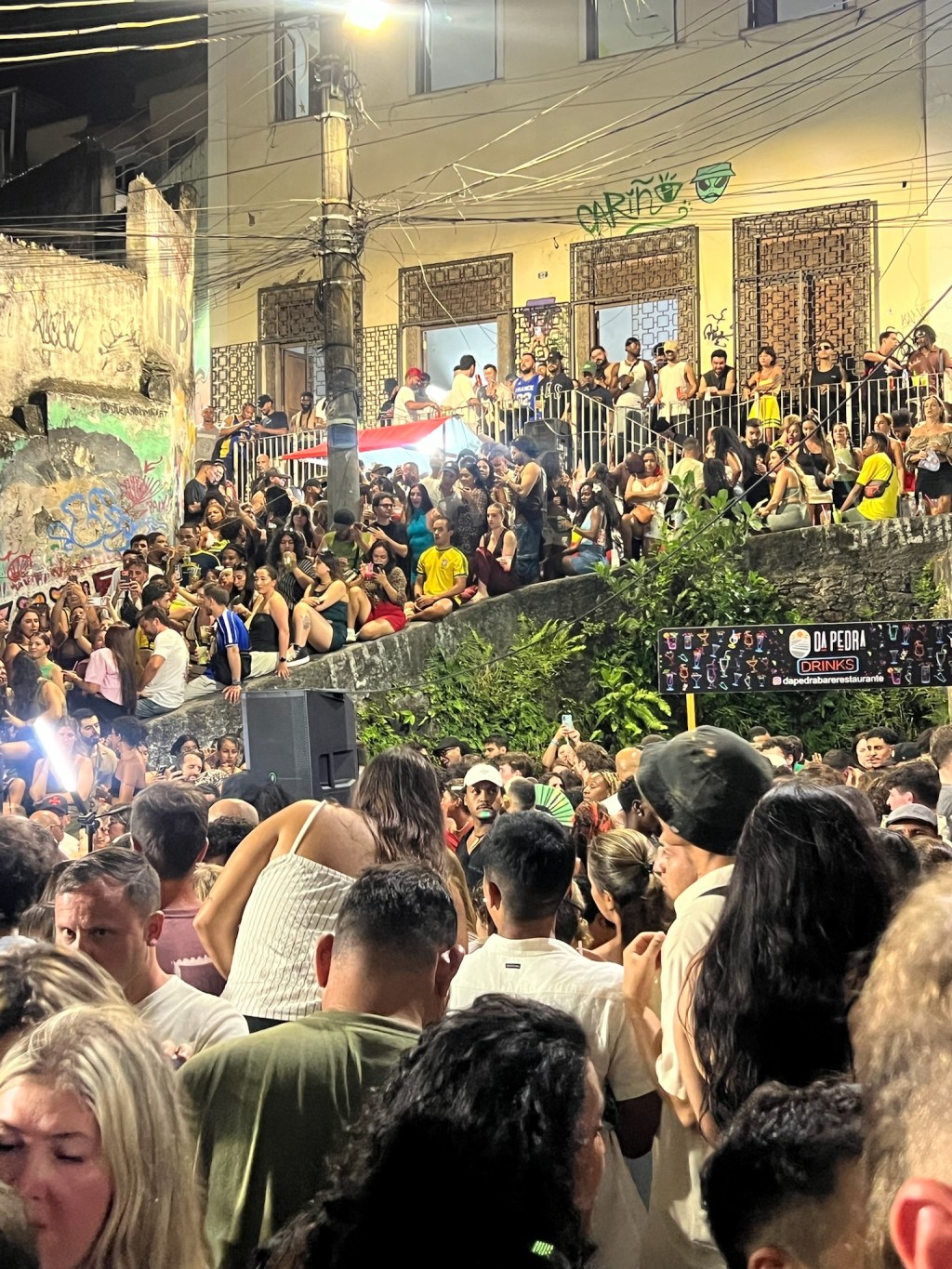
The people crowded the streets of Pedra do Sal, one of the most iconic neighborhoods in all of Brazil. Come each Wednesday night, food vendors selling sticks of roasted meats, grilled cheese skewers, cappirinhas, and fresh sliced fruit surrounded the streets of open wall clubs, all leading towards a live salsa band and spans of people weaving between each other, hip to hip, but dancing and alive. The entire city came out to celebrate a random night in the middle of the week, to dance with their neighbors and savor in fresh-cooked food. Pedra do Sal, another place anyone would say to never go, and yet so full of life. It was another beautiful part of our world that only curiosity can bring you to, another place to learn from-the upbeat rhythm of the dance, the laughter of the crowd, the friendly excitement of everyone combined-another place to learn to be alive.

