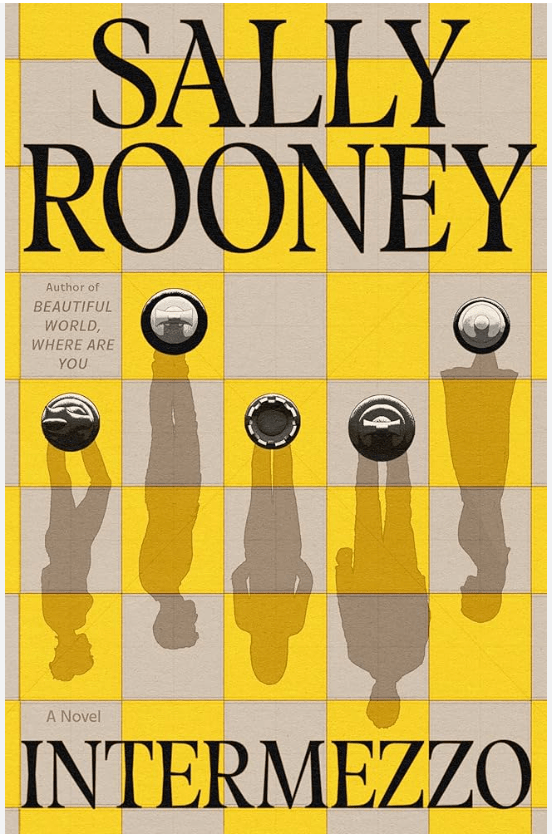
Sally Rooney’s Intermezzo captivates its reader through confusion as they waver between sympathy and disgust or pity and spite. The novel follows two brothers, Ivan and Peter, following the late passing of their father. They seek healing in the attentions of questionably aged women and encounter questions of family and brotherhood. Rooney captures the daily thoughts and burdens of each character in first person narration that swings impossibly close to living inside another person’s mind with fracturing interludes of thought, incomplete sentences that run into one another, and forced recallings of past traumas or mistakes. The style of narration places the reader as close to the characters as the written word can manage, and yet by the novel’s end, both brothers are unknown. Their opinions of each other conflict, their opinions of themselves are revolutionized by their own contrasting valorization and constant self-condescension, and their stories are filtered through their own perceptions. The reader can only know the characters as they want to be seen unless extraneous circumstances intervene forcing the truth to emerge, and even then doubt still exists.
The closeness of narration mirrors that of sections of James Joyce’s Ulysses, a novel that was praised for being a mastery of the public psychology of Dublin. Leopold Bloom, the central protagonist in Ulysses, surveys the world around him with a constant attention to detail which both transforms each scene into a fully stenciled image and offers insight to Bloom’s daily thoughts or more specifically, his being. Bloom, in his closeness to the reader, offers a truly realistic relationship in which the faults of a character can not be ignored, but also can not make them hated. The reader must follow Bloom as he voyeuristically watches women, going so far as to ejaculate on a beach while staring at a young girl or sneaking into the front section of a house to watch a woman’s ham-like rump as she beats dust from laundry. And yet the reader also witnesses moments of immense sweetness as Bloom coos at his cat, prepares his wife breakfast in bed while ignoring her impending affair, and seeks out a fatherly relationship with a drunken, young man lost in Dublin’s red light district, to reconcile his own poor relationship with his father. The polarity of these actions forces the reader to see every side to Bloom, the good and the bad, thus making their opinions towards Bloom waver between admiration and judgement.
It is this reality and closeness of interaction that Sally Rooney sought in her novel Intermezzo. She wrote of the world in between time, emotion, and death. This world which represents the complexities of human emotion could not be represented by characters who rely on the binaries of fiction leading to the choice of narrative style. She wrote her characters daily monologues to both obscure and present them as is the most realistic way. Intermezzo is a novel about the growth, change, and meaning within transition. The novel shows the changes brought about by death which renew individuals’ perspectives and force them to confront their own life values. Like the intermezzo of a play or an opera, infinite change can occur in the brief time between the beginning and end or in this case the time before and after the death of a father.
It seems unlikely to compare the work of a famous Irish novelist which depicted the transformation of the mythical Odyssey into a single day – June 6, 1904 – with the prose of contemporary Irish fiction which can be categorized as either romance or drama and spans multiple months. And yet, both novels succeed in the same goal, to write a character so meticulously and vividly that they become real. Further, both novels confront the impact or lack thereof of the father figure. Young men wander Dublin, unsure of their ambitions or desires, in the wake of the loss of the father – Ivan and Pete through death and Stephan Dedalus through ostracization. Two novels which stem from entirely different time periods and are affected by diverging social values and societal expectations share these fundamental elements – the importance of human connection as represented by the father and the inexplicable variety to the human personality which can extend both to good and evil without ever leaving either sphere.
Ulysses, which deals with Irish nationalism, sexism, and anti-semitism concludes with no real change or grounds for reunification in a decaying marriage . The moral lies in the acceptance of people for who they are, for their wrongs or unlikeable characteristics. Bloom can forgive his narcissistic wife for her affair and Molly Bloom can forgive her husband for his inattentiveness, stupidity, and objectification of every woman on the street. Thus, neither character is perfect because Joyce didn’t write heroes, but people. Ulysses urges the reader to find pleasures in the simpleness of life and acceptance in the imperfections of people. The work of Joyce transforms an age-old epic into a call to remembrance of the individual within an isolating and dehumanizing society. It urges the reader to embrace diversity in response to exclusionary nationalist movements which transformed the oppressed Irish people into an entity which also oppressed its own people should they not perfectly conform to societal norms.
Sally Rooney’s Ireland maintains the same cold grey quality as Joyce’s Ireland. In the background lingers the death of the two protagonists’ father, divided families, and societal judgement. Pete can’t be with his first love ever since she suffered an accident due to her fear that she can no longer provide what a woman should; nor can he be with his younger girlfriend due to his fear of judgment being passed at their age difference. Similarly, Ivan, the younger brother, can’t take his relationship with his older and still-married girlfriend public due to her fear of societal condemnation, particularly by her mother. The two brothers find solace from their own fractured relationship as ruptured by grief and the trials of growing up in their budding relationships, and thus a similar theme to Ulysses emerges. The characters are not facing the isolation of an industrialized and capitalistic society, but of a family torn asunder by death, unkindness, and misunderstanding. Pete views Ivan as a perverted, sexist fool while Ivan views Pete as a narcissistic and careless, pompous ass. Their hatred of one another provides opposite representations of each character as offered by the sections they narrate, completing the images of realistic individuals inundated with imperfections. However, come the novel’s end Rooney writes of hope for their reconciliation as they plan to spend the next summer together with their respective partners. Rooney, just as the great Irish Novelist, Joyce, wrote of the need for acceptance of faults and reunification in the pursuit of happiness. The brothers will only find peace when they can forgive one another and more so forgive themselves for their own roles in their ostracization. Intermezzo, thus becomes a novel about forgiveness in the face of loss and of acceptance as a mode of healing.
Two very different writers from two exceedingly different time periods, one in an age of cultural divide, another an age of technological isolation, and yet their works evoke the same theme. They emphasize the pointlessness of life and the subsequent need for finding meaning in experiences and human connection. They both warn of the dangers of miscommunication or misunderstanding due to a lack of familiarity with the other that waver outside comfort. Both authors prove the essentialness of preserving relationships and connections for the betterment of both the individual experience and the betterment of society.
In the modern day US, both cultural and technological division plague society. The attentiveness to actual events, legislation, and cultural movements has drastically decreased with the rise of social media all the while bias-confirming information is streamlined to everyone’s personal devices. The result is division, defensiveness, and an inability to politically organize despite the rising state of authoritarianism. In the last week alone, US President Donald Trump has both taken national control of the DC police sector and claimed that the Smithsonian Museum Coalition focuses too much on the negative effects of slavery leading to the removal of 32 exhibited items from the National African American History and Culture Museum. People in the US are divided, unable to recognize the communal wrong of such actions, and unwilling to alter their opinions or justifications due to a culture of information bias and confirmation which has corrupted the pursuit of truth, dignity, and freedom.
This corruption of truth has been combatted time and time again by political speakers, activists, artists, philosophers, and as has been noted in this paper, writers. Two Irish writers, Joyce and Rooney wrote novels about humanity, connection, and the importance of acceptance. While it can not be said that these writers published their works with no political motives, especially considering the known criticism of Irish nationalism as presented by Ulysses, that does not denote the importance of their lessons. Both writers wrote realist narratives that skimmed the surface of the human consciousness, a place where truth can not be denied as it floats so closely to reality. Both writers proved through their exploration of human psychology that no one individual can ever be right or perfect in totality as the hero does not exist. The hero is not human. The hero is not reality.
The lessons of literature seem to have been forgotten in the current political climate which neglects the individual, the soul, and humanity. Artificial institutions have usurped our freedoms, and literature offers a connection with truth and a way to remember reality. It requires methodical interpretation and analysis that can’t be corrupted as to corrupt a literary analysis would be to corrupt the human experience beyond belief. Joyce and Rooney together bridge the divide between the past and present and call for a return to critical thinking and connection, the only tools which could potentially save the world as it is. They wrote of people, thus proving that every individual deserves redemption or care, a lesson which must be remembered, even when applied to someone infinitely different from ourselves.
 Aubrey Wallen Literary Journal and Papers
Leave a comment