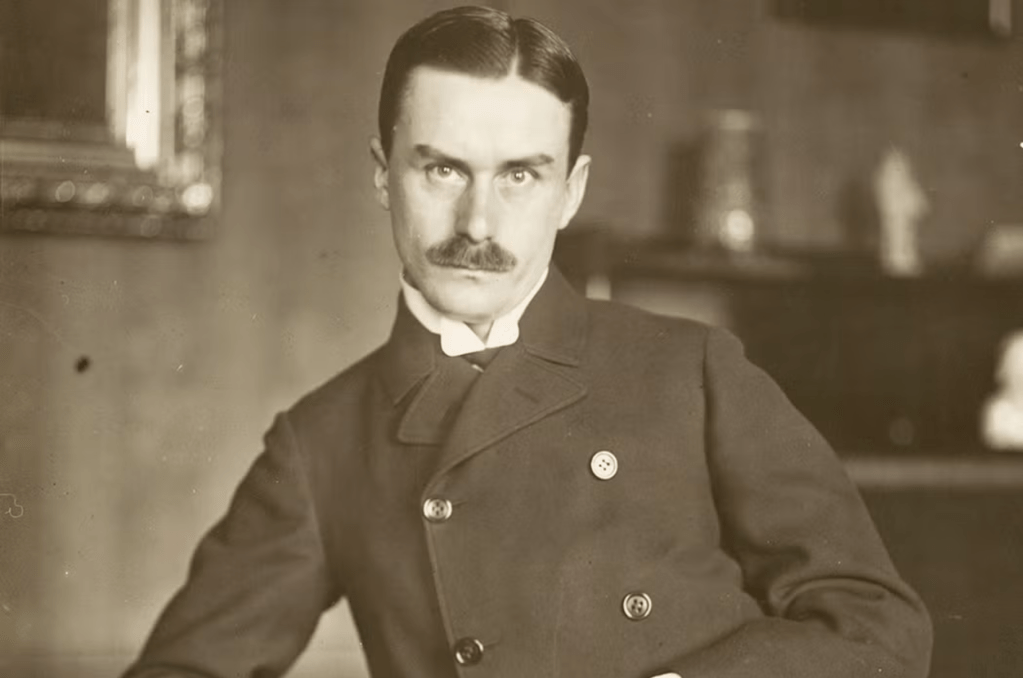
The most recurrent annoyance I had while reading Thomas Mann’s The Magic Mountain was my inability to understand the purpose of Hans Castorp spending his seven years at the Berghof Sanatorium, which while not a flaw in the writing should be examined as the strongest potential for Mann’s intention. Clearly, Castorp was indoctrinated by the Berghof’s culture and attached to its patients, perhaps even to the carefree lifestyle compatible with his bourgeois aspirations, but no matter the explanation he was man spending years of his life in a Sanatorium of which he only departed come the onset of World War One. It was in the Sanatorium under a Doktors diagnosis of a wet cavity in the protagonists upper body that Castorp gained admission for an extended stay at the Berghof which lasted for seven years during which he lost contact with his life in the flatlands due to both death and time. The Berghof negated the possibility of any other possible means of existence for Castorp until 1914 when the Sarajevo assassination initiated Europe’s fracturing and the death of the bourgeois lifestyle which Hans enjoyed atop the Mountain.
A Sanatorium which served as more of an enabler of a labourless, bourgeois lifestyle for Hans until its destruction in 1914 then seems to serve as a nationless center of intellectual and philosophical debate across the many cultures and values of its inhabitants. Patients visited the Berghof from Germany, Russia, Mexico, Poland, Sweden, and so on. These people of a variety of cultures lived together in a Sanatorium atop a mountain that though located in the Swiss Alps belonged to no nation in actuality. The Sanatorium was suspended from any sense of nation, place, time, or any other connection to reality, allowing for the freedom to engage in intellectual discourse that would have been frowned upon due to social conventions of any one place with a predetermined set of values. The Magic Mountain, while not actually magic, provided a separation from customary social conventions that enabled a vast expansion of ideas amongst its patients, a privilege that was only afforded them by their ability to dedicate years of their life and a constant expenditure to the Berghof.
Thus, a stay at a Sanatorium which never actually cured its patients of their ailments becomes appealing for far different reasons than just laziness or indoctrination. Rather, Hans Castorp sacrificed years of his life to the Sanitorium in exchange for intellectual freedom, making his extended break from reality into the most fulfilling years of his life. He no longer studies engineering, a pursuit that only held motivation in monetary value, and expands his brain into the humanities and other sciences under the tutelage of an Italian humanist, Settembrini. The reader then, in following the tale of Hans enters a world of intellectual stimulation that serves as an argument in favor of humanistic ideals of encouraging the constant permeating of oneself with knowledge, even beyond what one is culturally familiar or comfortable with. Through repeating descriptions of the monotonous arganization of the daily routine at the Berghof Mann furthers this invitation as with a structurally repeating the plot the novels source of pleasure becomes the discourse of the inhabitants who all represent varying cultures or ideological systems. Thus, Mann’s novel offers proposes the sharing of knowledge in separation from cultural divisions and judgments as caused by national prejudices and growing tension before the onset of WWI as the ideal means of living and the privilege of the bourgeois.
 Aubrey Wallen Literary Journal and Papers
Leave a comment