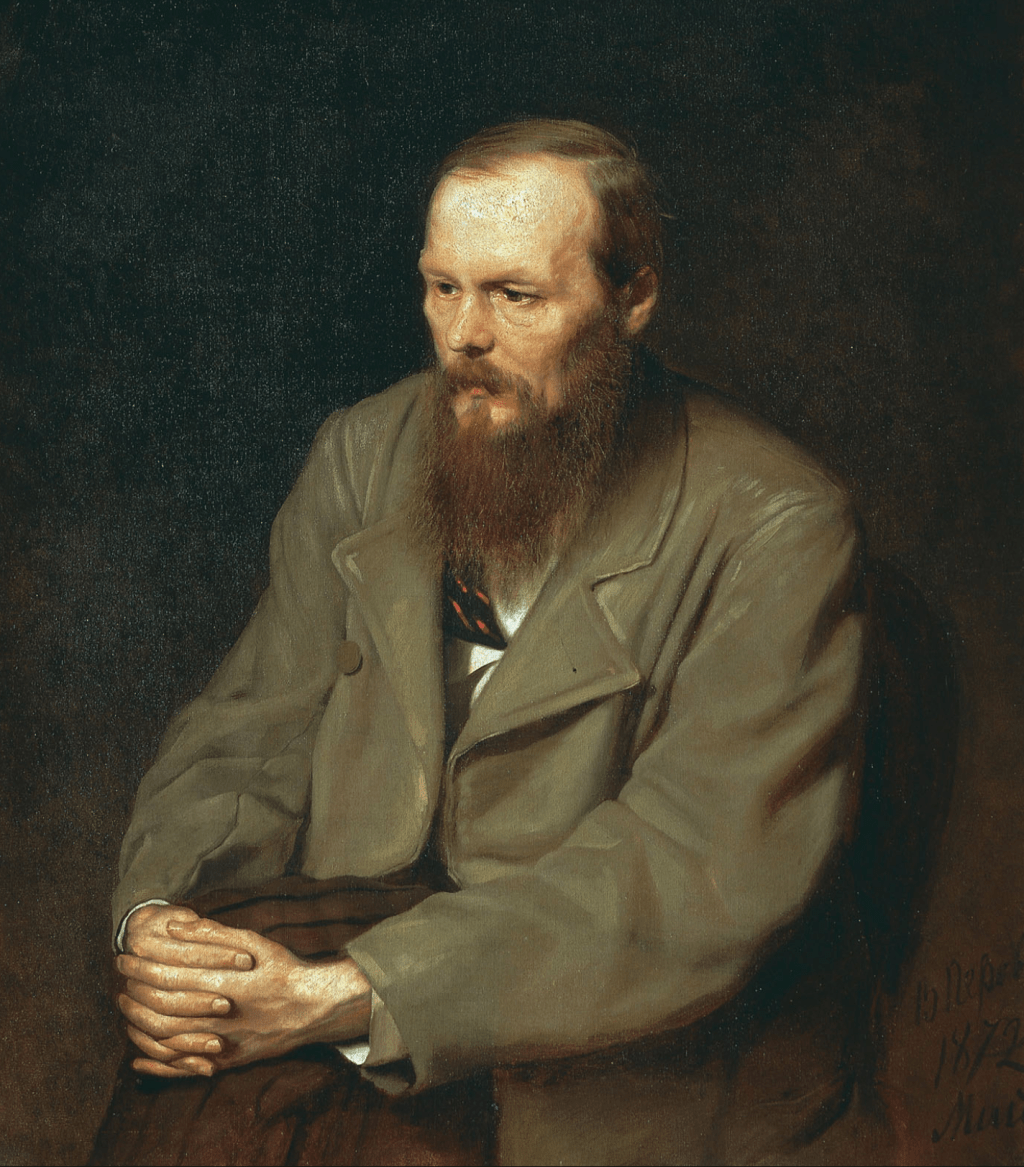
Dostoevsky’s Demons begins with 400 pages exploring the Russian bourgeois and the frivolous and fickle nature of social conventions that do nothing but create confusion and misfortune for the characters. Stepan can not confess love, nor reject a marriage he does not want without social repercussions just as a lame woman can not escape her abusive brother or share her hidden unconsummated marriage due to her station. The entirety of the novel takes place in a game of social etiquette obscuring truth and making it easy to eliminate the value of life from one’s conscience as these conventions serve to eliminate meaning by making life seemingly pointless. This pointless feeling created by strict conventions that remove one’s innate connection from experience and the natural world, entering them into a nihilistic perspective.
Within the novel a nihilist rebellion seeks to overthrow the Russian aristocracy, being headed by Pytor Stepanovich. The group makes their first movement by usurping a reading at a ball hosted by the governor’s wife in an attempt to destroy her credibility and invoke chaos and outrage before continuing on a spree of murders, each concealed by the tight secrecy of the Society. Their goal is to destroy the aristocracy as that is the essential first step to overthrowing the society they disdain. However, beyond destruction, there appears no set aim of the Society. They simply want to destroy a social system that values some more than others based on false conventions manufactured to uphold said conventions. They want to destroy it and to incite chaos, and yet have no ideas for what would make a better organized society. The Society functions on nihilistic whims and vengeance, but with no value in meaning, they offer no counter solutions for betterment. Further, this aimless society blindly follows Pytor Stapanovich’s personal ambitions as he as a person offers the most inspiration to those who have no ideals to inspire them.
Pytor Stepanovich’s charismatic and calculating manner however, doesn’t just strive for the destruction of society but facilitates a fascist leadership for the rebellion, a fascist leadership that nihilistic philosophy paves the way for him to uphold. He forces members of the Society to murder one of their own, burns a portion of a city to the ground, and forces a man to commit suicide and confess to the Society’s crimes on his death note. All of these ruthless acts are in the name of the destruction of the old society, designed to create chaos and from the ruins Pytor believes a new better society will grow, but with no values to govern the new society Pytor’s rebellion becomes pointless destruction headed by murderous fascism. Dostoevsky’s work is known for its condemnation of nihilism and Pytor’s failed attempt to facilitate a nihilist social movement which results only in death and fascism embodies this condemnation. In writing Demons, Dostoevsky sought to show how the elimination of meaning has dangerous repercussions. Without meaning, the idea of evil disappears and Pytor can continue to manipulate and murder people without consequence. Without meaning a social movement has no motivation and thus a controlling individual can corrupt and control an entire ideological system for their own gain. A nihilistic society thus, removes the regulation that protects the humanity of a society and the protections provided by pre-organized institutions. This is not to say that the Russian aristocracy should have been upheld and that a society that opposes such an institution is wrong, but that in order for a social movement to take place that there must be ideological goals and aspirations in separation from any one individual.
 Aubrey Wallen Literary Journal and Papers
Leave a comment